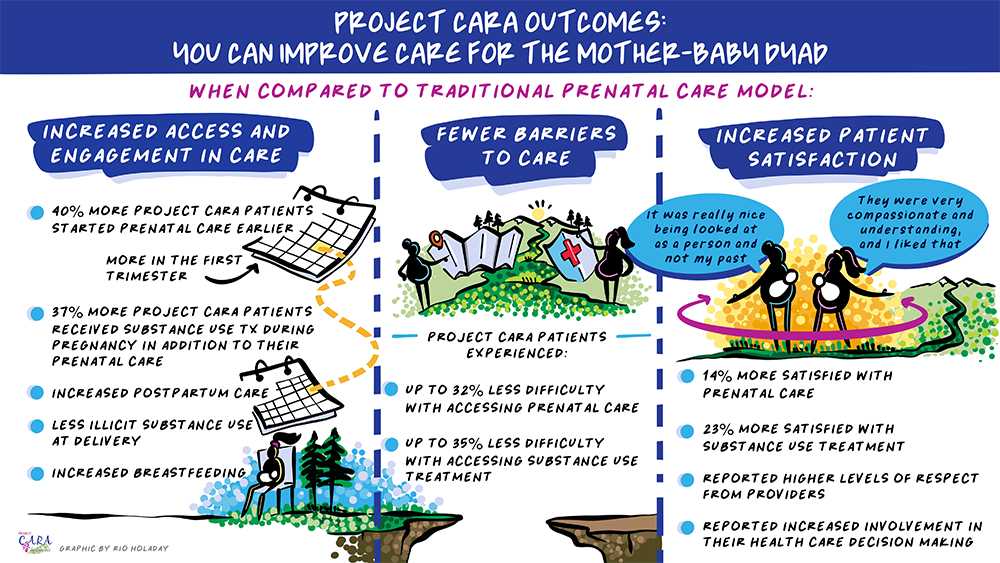
A colorful infographic titled “Project CARA Outcomes: You Can Improve Care for the Mother-Baby Dyad” is displayed on a blue banner at the top. Beneath the title, a subtitle reads: “When compared to traditional prenatal care model:” The infographic is divided into three vertical sections separated by dashed lines. Each section combines text, icons, and illustrations.
Left Section: A blue heading reads “Increased Access and Engagement in Care.” Below are bullet points with small circular markers and simple illustrations of calendars and a seated person outdoors. Text states: “40% more Project CARA patients started prenatal care earlier, more in the first trimester.” “37% more Project CARA patients received substance use treatment during pregnancy in addition to their prenatal care.” “Increased postpartum care.” “Less illicit substance use at delivery.” “Increased breastfeeding.”
Middle Section: A blue heading reads “Fewer Barriers to Care.” This section includes an illustration of an open book with a path leading through hills and a medical cross symbol. Text states: “Project CARA patients experienced:” “Up to 32% less difficulty with accessing prenatal care.” “Up to 35% less difficulty with accessing substance use treatment.”
Right Section: A blue heading reads “Increased Patient Satisfaction.” An illustration shows two figures connected by a curved path, surrounded by colorful dots, with speech bubbles. The speech bubbles read: “It was really nice being looked at as a person and not my past.” “They were very compassionate and understanding, and I liked that.”
Bullet points below state: “14% more satisfied with prenatal care.” “23% more satisfied with substance use treatment.” “Reported higher levels of respect from providers.” “Reported increased involvement in their health care decision making.”
The infographic uses a hand-drawn illustration style with bright colors including blue, green, yellow, and pink. Icons such as calendars, landscapes, and pathways visually support the data. The layout emphasizes improved access, fewer barriers, and higher satisfaction outcomes for patients in the Project CARA program.
At the bottom left corner, small text reads: “Project CARA” and “Graphic by Rio Holaday”.